Online Higher Education Trends 2026: What’s Next?

The landscape of online higher education is rapidly evolving, with 2026 poised to see significant shifts towards AI-driven personalization, expanded micro-credentialing, immersive learning technologies, and greater global accessibility to quality education.
As we approach 2026, the discussion around online higher education trends is more dynamic and critical than ever. The rapid advancements in technology, coupled with evolving student and workforce demands, are reshaping how universities deliver education and how learners engage with it. This article explores the key transformations expected to define the future of digital learning, offering insights into what students, educators, and institutions can anticipate in the coming years.
Personalized Learning Journeys Powered by AI
The concept of a one-size-fits-all education is quickly becoming obsolete, particularly in the online realm. By 2026, artificial intelligence (AI) is expected to be a cornerstone of personalized learning, adapting educational content and pace to individual student needs and preferences.
AI algorithms will analyze student performance, learning styles, and engagement patterns to create highly customized educational paths. This will allow for more efficient and effective learning, addressing specific knowledge gaps and enhancing strengths in real-time. The goal is to move beyond static course materials to dynamic, responsive learning environments.
Adaptive Content Delivery
AI will revolutionize how course materials are presented. Instead of generic lectures, students will receive content tailored to their individual learning pace and prior knowledge.
- AI tutors providing instant feedback and support.
- Dynamic curriculum adjustments based on student progress.
- Personalized recommendations for supplementary resources.
- Automated assessment tools offering detailed performance analytics.
The integration of AI will not only benefit students by making learning more engaging and effective but also empower educators with data-driven insights to refine their teaching methodologies. This shift promises a more inclusive educational experience, accommodating a wider range of learners and their unique requirements.
Ultimately, personalized learning, driven by sophisticated AI, will become a standard expectation in online higher education, ensuring that each student receives the most relevant and impactful educational journey possible.
The Rise of Micro-credentials and Stackable Programs
Traditional degree structures are increasingly being complemented, and in some cases, challenged, by more flexible and career-focused alternatives. By 2026, micro-credentials and stackable programs will play a much more prominent role in online higher education, reflecting the demand for agile skill development.
These shorter, competency-based certifications allow learners to acquire specific skills quickly and efficiently, making them highly attractive to working professionals and those seeking to upskill or reskill. Universities are recognizing this demand and developing modular programs that can be combined to form larger qualifications.
Flexible Skill Acquisition
Micro-credentials offer a direct response to the rapidly changing demands of the job market. They provide a quicker route to gaining specialized knowledge without the time and financial commitment of a full degree program.
- Digital badges and certificates validating specific skills.
- Pathways for combining multiple micro-credentials into a larger degree.
- Industry-recognized certifications enhancing employability.
- Opportunities for continuous professional development.
The appeal of stackable programs lies in their adaptability. Students can build their education incrementally, earning credentials that are immediately applicable to their careers while working towards a broader qualification. This model provides unparalleled flexibility, allowing learners to tailor their educational journey to their evolving career goals and personal circumstances.
This trend signifies a move towards a more granular and responsive educational ecosystem, where learning is an ongoing process rather than a one-time event, making education more accessible and relevant to a diverse population.
Immersive Learning Technologies: VR and AR
Beyond traditional video lectures and online discussions, online higher education in 2026 will increasingly leverage immersive technologies like Virtual Reality (VR) and Augmented Reality (AR) to create engaging and experiential learning environments. These technologies bridge the gap between theoretical knowledge and practical application.
VR and AR offer unparalleled opportunities for simulations, virtual field trips, and hands-on experiences that were once limited to physical classrooms or laboratories. This allows students to interact with complex concepts and scenarios in a safe, controlled, and highly interactive digital space.
Virtual Labs and Field Trips
Imagine conducting complex scientific experiments in a virtual lab or exploring ancient ruins on a virtual field trip, all from the comfort of your home. VR and AR make these experiences possible, enhancing comprehension and retention.
- Realistic simulations for medical, engineering, and scientific fields.
- Interactive historical and cultural explorations.
- Collaborative virtual spaces for group projects.
- Enhanced visualization of abstract concepts in mathematics and physics.
The integration of VR and AR not only enriches the learning experience but also addresses issues of accessibility, allowing students from anywhere in the world to participate in high-quality, immersive education. These technologies transform passive learning into active engagement, fostering deeper understanding and critical thinking skills.
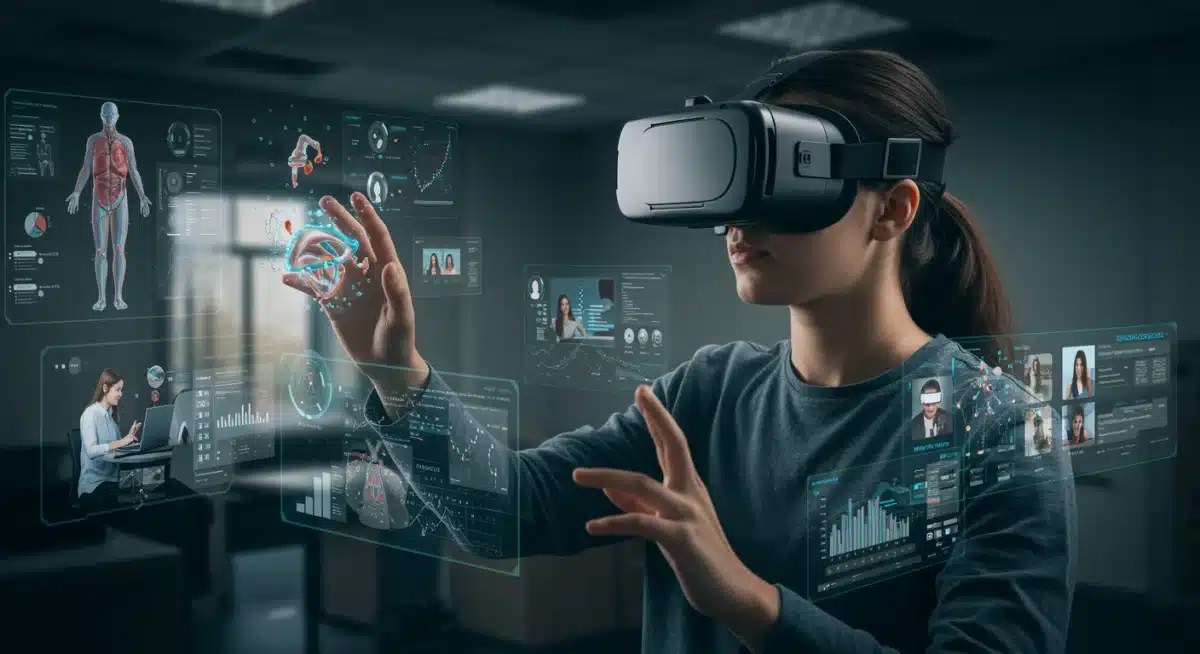
As the cost of these technologies decreases and their accessibility increases, their adoption in online higher education will become more widespread, offering a truly transformative educational experience.
Global Accessibility and Cross-Border Collaboration
Online higher education is inherently global, and by 2026, this aspect will be further amplified, leading to unprecedented levels of cross-border collaboration and accessibility. Institutions will increasingly partner internationally to offer diverse programs and foster a truly global learning community.
This enhanced global reach means that students will have access to a wider array of specialized courses and expert faculty from around the world, irrespective of their geographical location. It also promotes cultural exchange and understanding, preparing graduates for an interconnected global workforce.
International Partnerships and Programs
Universities are forging alliances across continents to create joint degree programs and exchange knowledge, enriching the educational offerings for all students.
- Joint degrees offered by institutions in different countries.
- Virtual exchange programs fostering cross-cultural understanding.
- Access to specialized courses from leading global universities.
- Collaborative research projects involving international student teams.
The focus on global accessibility extends beyond just offering courses internationally; it also involves addressing digital divides and ensuring that technology is available and affordable for all potential learners. Initiatives to provide low-cost internet access and devices will be crucial in realizing this vision.
Ultimately, online higher education in 2026 will be characterized by its borderless nature, offering unparalleled opportunities for students to connect, learn, and collaborate on a global scale, preparing them for the challenges and opportunities of a globalized world.
Data-Driven Decision Making and Institutional Efficiency
The vast amounts of data generated by online learning platforms offer invaluable insights that, by 2026, will be systematically leveraged for data-driven decision making in higher education. This will lead to improved institutional efficiency, optimized student support, and enhanced educational outcomes.
Analytics will inform everything from curriculum design and teaching methodologies to student retention strategies and resource allocation. Institutions will move beyond reactive measures to proactive interventions, ensuring a more effective and responsive educational system.
Optimizing Student Success
By analyzing student engagement, performance, and feedback, institutions can identify at-risk students sooner and provide targeted support, improving completion rates and overall satisfaction.
- Predictive analytics for student retention and success.
- Personalized support interventions based on data insights.
- Continuous improvement of course content and delivery.
- Efficient allocation of faculty and technological resources.
The use of data will extend to administrative processes, streamlining operations and reducing costs, allowing universities to invest more in core educational activities. This analytical approach ensures that educational strategies are evidence-based and continuously refined to meet the evolving needs of students and the job market.
In essence, data-driven decision making will transform online higher education into a more intelligent, adaptable, and student-centric system, fostering a culture of continuous improvement and innovation across all institutional levels.
Emphasis on Lifelong Learning and Reskilling
The acceleration of technological change and economic shifts means that a single degree is no longer sufficient for a lifelong career. By 2026, online higher education will place an even greater emphasis on lifelong learning, offering accessible pathways for reskilling and upskilling throughout an individual’s professional life.
This paradigm shift recognizes that learning is a continuous journey, not a destination. Universities will evolve to become lifelong learning partners, providing modular courses and specialized programs that cater to the ongoing development needs of the workforce.
Continuous Professional Development
Online platforms are uniquely positioned to deliver flexible and accessible learning opportunities that fit into the busy schedules of working professionals, enabling them to stay current with industry demands.
- Short courses and bootcamps for rapid skill acquisition.
- Partnerships with industries to offer relevant training.
- Subscription-based learning models for continuous access.
- Certification programs for specialized professional competencies.
The focus will be on creating seamless transitions between education and employment, ensuring that learners can continuously update their skill sets to remain competitive in a dynamic job market. This includes providing clear pathways for professionals to switch careers or deepen their expertise in existing fields.
The commitment to lifelong learning positions online higher education as a vital resource for economic resilience and personal growth, ensuring that individuals can adapt and thrive in an ever-changing world.
| Key Trend | Brief Description |
|---|---|
| AI-Powered Personalization | Tailoring learning paths and content to individual student needs using artificial intelligence. |
| Micro-credentials Growth | Focus on flexible, competency-based certifications for rapid skill acquisition and career advancement. |
| Immersive Learning (VR/AR) | Utilizing Virtual and Augmented Reality for experiential and highly engaging educational experiences. |
| Global Accessibility | Expanding international partnerships and reach, making quality education available worldwide. |
Frequently Asked Questions About Online Higher Education in 2026
AI will analyze your learning style, pace, and performance data to recommend specific resources, adjust content difficulty, and provide real-time feedback. It will create a dynamic learning path tailored to your individual needs, ensuring you focus on areas where you need the most support or challenge.
Micro-credentials are short, focused certifications that validate specific skills or competencies. They are crucial because they offer flexibility, allowing professionals to quickly acquire relevant skills for the evolving job market without committing to a full degree, making lifelong learning more accessible.
Yes, by 2026, VR and AR are expected to be more common, especially in fields requiring practical experience. They will enable immersive simulations, virtual labs, and interactive field trips, transforming theoretical learning into engaging, hands-on experiences that enhance comprehension and retention.
Global accessibility will increase through international university partnerships, joint degree programs, and virtual exchange initiatives. Efforts to bridge the digital divide by providing affordable internet and devices will also play a key role, making quality education available to a wider global audience.
Online institutions will offer more short courses, bootcamps, and stackable programs designed for continuous professional development. They will partner with industries to provide relevant training and flexible learning models, enabling individuals to continually update their skills and adapt to new career demands throughout their lives.
Conclusion
The trajectory of online higher education towards 2026 is one of profound transformation, marked by innovation and an unwavering commitment to learner success. From AI-driven personalization to the widespread adoption of micro-credentials and immersive technologies, the future promises a more flexible, accessible, and highly effective educational landscape. These evolving trends underscore a critical shift: education is becoming a continuous journey, tailored to individual needs and responsive to global demands. As institutions and learners adapt, the potential for online learning to empower individuals and shape a more skilled, adaptable global workforce is immense, truly redefining what it means to learn and grow in the 21st century.